 Wayther

Towing a Trailer in Wind and Rain
Learn how wind, rain, and changing weather affect towing a trailer, and how to plan your route and departure time before a long drive.
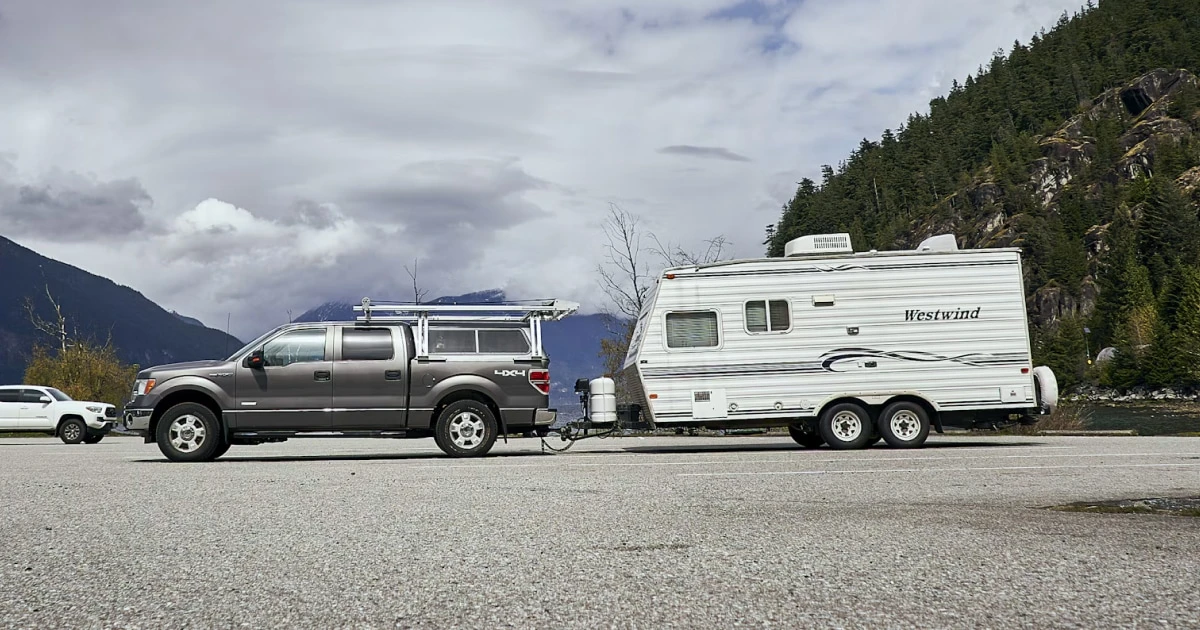
Towing a trailer changes how your vehicle responds to the weather. A crosswind that feels manageable in a car can exert considerable force on a large caravan or travel trailer. Heavy rain can also make it harder to see, reduce tire grip, and increase the distance needed to stop.
These conditions can become more challenging on exposed motorways, bridges, open plains, coastal roads, and mountain passes.
Planning a towing trip therefore involves more than checking the forecast at your destination. You need to consider the wind and precipitation expected along your entire route, at the times you will be driving.
1. Check wind speed and gusts before towing
Wind is one of the most important weather variables to consider when towing a trailer.
A trailer has a larger exposed surface area than the towing vehicle alone. Wind can push against that surface, particularly when it blows across the direction of travel.
When checking the forecast, look at both sustained wind speeds and gusts.
- Sustained wind speed describes the average wind over a specified period.
- Wind gusts describe brief increases in wind speed that can place additional demands on vehicle control.
A forecast with moderate sustained winds but stronger gusts may deserve particular attention, especially on exposed roads.
Wind direction matters too. A headwind, tailwind, and crosswind affect a vehicle-trailer combination differently. A crosswind can push the trailer sideways, while changing wind direction can make conditions less predictable.
There is no universal wind-speed threshold that makes towing safe or unsafe for every combination. The effect depends on the trailer’s size and shape, its loading, the tow vehicle, road conditions, and the driver’s experience.
Check the vehicle and trailer manufacturers’ guidance, and follow any restrictions or warnings issued by the relevant authorities.
2. Identify exposed sections of your route
The wind forecast at your departure point may not reflect the conditions you will encounter later.
Some sections of a journey are more exposed to wind than others:
Bridges and elevated roads
Bridges can be exposed to crosswinds and may have specific restrictions during severe weather. Check official road information for closures or limits affecting vehicles towing trailers.
Coastal roads
Open coastlines can experience strong winds, and conditions may change as the route follows the shoreline or turns inland.
Open plains and farmland
With fewer natural obstacles, these areas can expose a trailer to sustained winds and sudden gusts.
Mountain passes and valleys
Wind can vary considerably with terrain and elevation. A sheltered valley may be followed by an exposed pass where conditions are very different.
Gaps between buildings or roadside barriers
Local changes in exposure can make wind feel inconsistent along a road. A trailer may move differently as the vehicle passes from a sheltered section into an exposed area.
When planning a long trip, check the forecast at several points along the route rather than relying on one regional wind estimate.
Wayther helps you review forecast conditions along a driving route, including wind and gusts where data is available. This can help you identify sections that deserve closer attention before departure.
3. Understand trailer sway and wind-related risks
Trailer sway is a side-to-side movement of a trailer that can affect the stability of the entire vehicle combination. It may be influenced by wind, speed, loading, trailer design, road conditions, and other factors.
A strong gust can push against the trailer, while passing large vehicles may create additional air disturbances.
Good preparation matters:
- Respect the maximum towing limits specified by the vehicle and trailer manufacturers.
- Load the trailer according to the manufacturer’s instructions.
- Secure cargo so that it cannot shift during the journey.
- Check the hitch, coupling, safety connections, and tires before departure.
- Use a suitable trailer-sway control system if specified or recommended for your setup.
- Drive at a speed appropriate for the conditions and within legal limits.
If the trailer begins to sway, avoid abrupt steering or braking. Follow the instructions in your vehicle and trailer manuals, and any guidance provided for your particular sway-control system. Reduce speed smoothly when it is safe to do so and stop at a suitable location to reassess the situation.
Do not assume that electronic stability or sway-control systems can compensate for unsafe loading, excessive speed, or severe weather.
4. Check for rain along the route
Rain introduces additional challenges when towing.
Reduced visibility can make it harder to anticipate hazards, while wet road surfaces can reduce available tire grip. Heavy rain may also create standing water, increasing the risk of losing control.
Before leaving, check:
- Where rain is expected along your route.
- Whether heavy precipitation is forecast during the hours you will be driving.
- Whether visibility may be reduced.
- Whether the route includes areas prone to flooding or standing water.
- Whether official weather warnings or road restrictions are in effect.
A route that starts in dry conditions may encounter heavy rain several hours later. This is particularly important when crossing large regions with different weather systems.
For more guidance, see Driving in Rain: Reading Road Conditions Along Your Route.
5. Choose your departure time carefully
If the forecast suggests strong winds or heavy rain, changing your departure time may help you avoid the most difficult period.
For example, a period of strong afternoon gusts may be expected to ease later in the evening. However, waiting until later is not automatically better: visibility, fatigue, other weather hazards, and local restrictions also matter.
Compare the conditions expected during the hours you will actually be towing.
Ask yourself:
- Are the strongest gusts expected during the exposed sections of the route?
- Would another departure time reduce exposure to forecast heavy rain?
- Will a later departure leave enough daylight and suitable places to stop?
- Could a change in departure time create fatigue or other safety concerns?
- Are authorities advising against travel during the forecast period?
Wayther allows you to compare forecast conditions for different departure times. Use that information to assess your options, not as a guarantee that a particular time will be safe for towing.
If the forecast indicates severe conditions, postponing the trip may be more appropriate than trying to find a better departure window.
6. Consider an alternative route
An alternative route may avoid an exposed bridge, a high mountain pass, or an area forecast to experience particularly strong winds.
However, the shortest route is not necessarily the best route for towing, and a longer route can introduce other hazards.
When comparing alternatives, consider:
- Forecast wind speeds and gusts.
- The direction of the wind relative to exposed road sections.
- Expected rainfall and visibility.
- Elevation changes and terrain exposure.
- Road restrictions for trailers and towing vehicles.
- Total driving time and opportunities to stop safely.
A route with lower forecast wind speeds may still be unsuitable if it includes narrow roads, difficult turns, steep gradients, or restrictions on towing.
Check official road information before changing your route, especially if you are towing a large caravan or trailer.
Wayther can help you compare forecast weather along available route alternatives. Combine that information with navigation, road restrictions, and your own assessment of the vehicle-trailer combination.
7. Prepare your vehicle and trailer
Weather planning should go hand in hand with a pre-trip inspection.
Before setting off, check the following.
Tires and loading
Inspect the tires on both the towing vehicle and the trailer. Check pressure when cold and follow the relevant manufacturer recommendations, taking account of the load.
Confirm that cargo is distributed and secured according to the trailer manufacturer’s instructions. Incorrect loading can affect stability and handling.
Coupling and connections
Check that the hitch or coupling is correctly secured and that required safety connections are in place. Confirm that lights and indicators work on both the vehicle and trailer.
Brakes and equipment
Make sure the braking system and any required trailer brakes are working properly. Check any towing-specific equipment and follow the manufacturer’s maintenance guidance.
Mirrors and visibility
Ensure that you can see safely around the trailer using suitable mirrors. Check the windscreen, wipers, lights, and washer fluid before travelling in wet weather.
Emergency preparation
Carry the equipment appropriate to your vehicle, trailer, route, and local regulations. Know where you can stop safely if the weather deteriorates.
If the vehicle or trailer has a known mechanical problem, resolve it before departure rather than relying on careful driving to compensate.
8. Adjust your driving when conditions deteriorate
Forecasts cannot describe every gust or wet patch you will encounter. Conditions on the road should determine how you drive.
When towing in wind and rain:
- Reduce speed when conditions require it.
- Leave a larger following distance to allow more time to react.
- Avoid sudden steering, acceleration, and braking.
- Be cautious when passing large vehicles or emerging from sheltered sections into crosswinds.
- Avoid driving through standing water when its depth or the condition of the road is uncertain.
- Follow variable message signs, restrictions, and instructions from authorities.
A trailer increases the demands on the towing vehicle, and stopping distances may be longer than when driving without a trailer.
If the wind becomes difficult to manage, visibility drops significantly, or conditions no longer feel safe, find a suitable place to stop. Do not stop on a dangerous shoulder or exposed section of road unless required by an emergency.
If authorities close a road or advise against travel, follow that guidance.
9. Use a towing weather checklist
Before a long towing journey, work through this checklist.
- Check wind speed and gust forecasts at several points along the route.
- Review wind direction and identify exposed bridges, plains, coastal roads, and mountain passes.
- Check rainfall and visibility forecasts.
- Review official weather warnings and road restrictions.
- Compare departure times if the forecast indicates a difficult weather window.
- Consider an alternative route if it meaningfully reduces exposure and is suitable for towing.
- Inspect tires, coupling, brakes, lights, mirrors, and safety connections.
- Secure the load and verify that towing limits are respected.
- Plan safe stopping places in case conditions deteriorate.
- Recheck weather and road information before departure.
Planning ahead will not remove every risk, but it can help you identify the conditions that deserve attention before you set off.
Plan your towing trip with Wayther
When towing, weather can affect the vehicle-trailer combination differently from a car travelling alone. Wind and gusts are especially important, and conditions may vary considerably between exposed and sheltered parts of a route.
Wayther helps you explore forecast weather along your driving route, compare departure times, and evaluate available route alternatives. You can review variables such as wind, gusts, precipitation, temperature, and visibility where forecast data is available.
Use Wayther to identify potentially challenging weather periods and compare your options before leaving. Combine the forecast with official road information, manufacturer guidance, and a proper inspection of your vehicle and trailer.
Wayther does not assess trailer stability, inspect your load, calculate your vehicle’s towing limits, or confirm real-time road conditions. It helps you plan around forecast weather, not guarantee that towing will be safe.
Frequently asked questions
- How much wind is too much for towing a trailer?
- There is no single wind-speed threshold that is safe for every vehicle and trailer combination. Risk depends on gusts, crosswind direction, trailer size and loading, vehicle characteristics, road exposure, and manufacturer guidance. If conditions feel unsafe or authorities advise against travel, stop safely or postpone.
- Are crosswinds more dangerous when towing a trailer?
- Crosswinds can exert substantial force on a trailer, particularly one with a large side area. Gusts and exposed roads can increase the challenge of maintaining control, so check wind forecasts and reduce speed when appropriate.
- Should I tow a trailer in heavy rain?
- Heavy rain can reduce visibility and tire grip, increase stopping distances, and create a risk of standing water. Consider postponing if conditions are severe, and follow official warnings and road restrictions.
- When is the best time to tow a trailer in windy weather?
- Compare wind and gust forecasts along your route for different departure times. Conditions may be more favourable during one period, but wind can vary by location and elevation. Do not use a forecast alone as proof that towing will be safe.
- Can Wayther tell me if it is safe to tow my trailer?
- No. Wayther helps you review forecast weather along a route and compare departure times or available alternatives. It does not assess your trailer's stability, load distribution, tow vehicle limits, or actual road conditions.
Before your next journey
Check the forecast for the road ahead.
Wayther is a road trip weather app for drivers, available on iPhone and iPad. It provides hour-by-hour road trip weather at every point on your route, timed to when you'll be there. Compare routes, find the best time to leave, plan 10 days ahead. Try it free.

Keep reading
Driving in Thunderstorms: What to Check Before You Leave
Learn how to plan a drive around thunderstorms, heavy rain, sudden gusts, hail and flash flooding, and when to delay your journey.
Driving in High Winds: What a Forecast Tells You and What It Doesn't
Learn how wind speed, gusts and direction affect driving, why high-sided vehicles are more vulnerable, and how to check wind forecasts along your route.
How to Plan a Road Trip Around the Weather
Plan your route, compare weather along the way, and find a better departure time. A step-by-step guide to planning a road trip around the forecast.